Ruy Lopez
The Ruy Lopez, also known as the Spanish Opening, begins after the moves 1.e4 e5 2.Nf3 Nc6 3.Bb5. It is one of the oldest, deepest, and most respected openings in chess, and is a favourite of players who want to apply long-term positional pressure without taking unnecessary risks.
- For white
- Classical
- Strategic
Written by:

The Essentials
- Early moves:
- 1.e4 e5 2.Nf3 Nc6 3.Bb5
- Colour:
- Played by White
- Style:
- Strategic, classical
- Learning Curve:
- High for both colours
- Named after:
- Ruy Lopez de Segura, a 16th-century Spanish priest
- Trivia:
- The Ruy Lopez is sometimes called the Spanish Torture because White can apply long-lasting pressure while Black struggles to fully equalise.
- Variations:
- Berlin Defence, Exchange Variation, Open Spanish, Arkhangelsk, Marshall Attack, Chigorin
- Good for:
- RapidClassicalBlitz
Best suited for rating
900-2400
Known for this opening
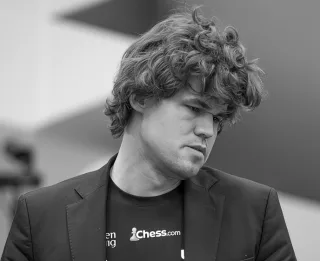
Magnus Carlsen

Bobby Fischer
Garry Kasparov

Vladimir Kramnik
Why play the Ruy Lopez?
The Ruy Lopez is the gold standard of 1.e4 openings.
After 1.e4 e5 2.Nf3 Nc6, 3.Bb5 develops a piece, prepares to castle, and puts immediate pressure on the knight that defends Black's e5-pawn.
The Ruy Lopez is not based on a cheap trick. It is a sophisticated opening built around accumulation: development, space, structure, king safety, and active pieces.
At beginner level, it teaches healthy habits. At grandmaster level, it becomes one of the most nuanced strategic battles in chess.
The opening can evolve in countless ways, from Berlin Defence endgames to the forcing theory of the Marshall Attack.
It teaches players how to squeeze, manoeuvre, prepare pawn breaks, and build pressure without rushing.
Try the Ruy Lopez yourself!
Why the Ruy Lopez is good with the:
Psychological edge - White can usually apply pressure without taking major risks, asking small questions for a long time.
Richness - The Ruy Lopez teaches so many different facets of chess that every game can feel like a lesson.
Abundance of choice - White can choose main lines, the Exchange Variation, quiet anti-Marshalls, and many other systems.
Suited for - Serious 1.e4 players who enjoy long games, slow pressure, and deep strategic battles.
Why the Ruy Lopez is good with the white pieces
Psychological edge - White can usually apply pressure without taking major risks, asking small questions for a long time.
Richness - The Ruy Lopez teaches so many different facets of chess that every game can feel like a lesson.
Abundance of choice - White can choose main lines, the Exchange Variation, quiet anti-Marshalls, and many other systems.
Suited for - Serious 1.e4 players who enjoy long games, slow pressure, and deep strategic battles.
Why the Ruy Lopez is good with the black pieces
Principles - Black echoes White in a classical, solid style, and there is nothing fundamentally wrong with Black's position if the opening is handled well.
Counter-attacking dreams - In variations such as the Marshall Attack and Open Spanish, Black can seize the initiative and change the pace of the game.
A lifetime repertoire - Black can specialise in the Berlin, Marshall, Breyer, Chigorin, or something more offbeat.
Suited for - Players who enjoy classical chess, theoretical battles, and patiently outlasting the opponent.
Strategy
Typical plans, pawn breaks, and key squares.
Pressuring e5
White's bishop attacks the knight on c6, increasing the pressure on Black's e5-pawn.
White's typical pawn breaks
White often prepares d4 and a4, with f4 appearing if Black allows it.
Black's typical pawn breaks
Black wants ...d5, ...c5, ...b5-b4, and sometimes ...f5 in sharper lines.
Key squares
The central and queenside squares decide many Spanish structures.
Traps and tactics
Three traps every Ruy Lopez player should know.
Themes
Black's breaks
The ...d5 break is usually Black's dream. If Black cannot achieve it, White may keep a lasting initiative.
Centre building
White often plays c3 and d4 to build a strong centre, prepared carefully with Re1, h3, and Nbd2.
Light-squared bishop
White's light-squared bishop is the soul of the opening, pressuring the knight on c6 and indirectly attacking the e5-pawn.
Manoeuvring
The Nbd2-f1-g3 manoeuvre is one of the most famous Ruy Lopez plans, slowly increasing kingside pressure.
History
From 16th-century Spain to the Berlin Wall and the engine era.
1561
Humble origins
Spanish priest Ruy Lopez de Segura analyses the opening in his famous chess book, and the idea of 3.Bb5 becomes associated with his name.
1800s
The classical era
The opening becomes increasingly popular as chess theory develops and masters understand White's long-term pressure against the e5-pawn.
1900-1950
Premier approval
The Ruy Lopez becomes one of the main battlegrounds of elite chess, with world champions such as Lasker, Capablanca, Alekhine, and Botvinnik contributing to theory.
1960-1990
The forging of deep theory
The Chigorin, Breyer, Zaitsev, and Marshall systems are analysed in huge detail, and the Ruy Lopez becomes central in world championship matches.
2000s
The Berlin Wall
Vladimir Kramnik uses the Berlin Defence to neutralise Garry Kasparov in their 2000 world championship match, transforming the line's reputation.
2020s
Age of technology
Modern engines show that the Ruy Lopez remains fully sound for both colours and one of the ultimate tests of chess understanding.
Model Games
Games that defined the Ruy Lopez.
FAQ
The Ruy Lopez is a chess opening that begins with the moves 1.e4 e5 2.Nf3 Nc6 3.Bb5. It is also known as the Spanish Opening. White develops the bishop actively, attacks the knight on c6, and applies indirect pressure to Black's e5-pawn.
Yes, but with a warning attached. The basic ideas are healthy: develop pieces, castle, fight for the centre, and build pressure. However, the Ruy Lopez contains a lot of theory, so beginners should focus on general plans rather than memorising endless variations.
Both openings begin with 1.e4 e5 2.Nf3 Nc6. In the Italian Game, White plays 3.Bc4 and aims directly at f7. In the Ruy Lopez, White plays 3.Bb5, attacking the knight that defends e5. The Italian is usually more direct, while the Ruy Lopez is deeper, slower, and more strategic.
The Berlin Defence begins after 1.e4 e5 2.Nf3 Nc6 3.Bb5 Nf6. It has a reputation as Black's most solid reply to the Ruy Lopez. In many lines, queens are exchanged early, leading to an endgame where White has a small initiative but Black is extremely solid.
The Marshall Attack is one of Black's sharpest weapons against the Ruy Lopez. Black sacrifices a pawn for rapid development, open lines, and attacking chances against White's king. Many grandmasters avoid it with anti-Marshall move orders.
There is no single best response. The Berlin Defence is preferred by players who want solidity. The Marshall Attack suits ambitious players who enjoy theory and initiative. The Closed Ruy Lopez is a classical choice, while the Open Ruy Lopez is more direct and dynamic.
Pretty much all of them. The Ruy Lopez has been played by world champions including Steinitz, Lasker, Capablanca, Alekhine, Botvinnik, Fischer, Karpov, Kasparov, Kramnik, Anand, Carlsen, and Ding.
Because it teaches proper chess. You develop naturally, fight for the centre, castle quickly, and apply pressure without overextending. It is challenging but rewarding, and can grow with you from beginner to grandmaster level.