'/%3e%3cdefs%3e%3clinearGradient%20id='paint0_linear_4129_14251'%20x1='-1946.01'%20y1='-1020.38'%20x2='-1885.54'%20y2='1277.69'%20gradientUnits='userSpaceOnUse'%3e%3cstop%20stop-color='%23DDD1F3'/%3e%3cstop%20offset='1'%20stop-color='%23DDD1F3'%20stop-opacity='0'/%3e%3c/linearGradient%3e%3c/defs%3e%3c/svg%3e)
Grünfeld Defence
The Grünfeld Defence begins after the moves 1.d4 Nf6 2.c4 g6 3.Nc3 d5. It is one of Black's most dynamic replies to 1.d4, chosen by players who like early imbalances and do not mind learning serious theory.
- For black
- Dynamic
- Theoretical
Written by:
The Essentials
- Early moves:
- 1.d4 Nf6 2.c4 g6 3.Nc3 d5
- Colour:
- Played by Black
- Style:
- Dynamic, theoretical
- Difficulty to learn:
- High
- Named after:
- Ernst Grünfeld, an Austrian grandmaster and opening expert.
- Trivia:
- Ernst Grünfeld played the Alekhine Defence more than Alekhine himself, while Alekhine played the Grünfeld Defence more than Grünfeld did.
- Variations:
- Exchange, Russian System, Bg5 systems, Bf4 systems, e3 setups, Fianchetto systems, 3.f3 Anti-Grünfeld
- Good for:
- BlitzRapidClassical
Best suited for rating
1000-2400
Known for this opening
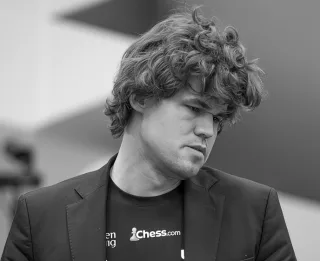
Magnus Carlsen

Garry Kasparov
.jpg)
Peter Svidler
.jpg)
Maxime Vachier-Lagrave
Why play the Grünfeld Defence?
The Grünfeld is one of the purest hypermodern openings in chess. Black invites White to build an impressive pawn centre, then tries to prove that the centre is overextended.
Against 1.d4, Black begins with 1...Nf6 and 2...g6. After 3.Nc3, the immediate 3...d5 defines the Grünfeld and starts the direct fight for the centre.
Black usually pressures d4 with the bishop on g7, the ...c5 break, active pieces, queen checks, and tactical threats.
The opening has been trusted by elite dynamic players including Garry Kasparov, Peter Svidler, Maxime Vachier-Lagrave, Bobby Fischer, Viktor Korchnoi, Boris Gelfand, and Ian Nepomniachtchi.
There are drawbacks. White's centre is real, many lines are deeply analysed, and Black often needs accurate knowledge well into the middlegame.
The reward is active piece play, clear counterplay, and genuine winning chances against 1.d4 without accepting a cramped position.
Try the Grünfeld Defence yourself!
Why the Grünfeld Defence is good with the:
Big centre - In most main lines, White gets a powerful pawn centre with pawns on c3, d4, and e4.
Constant alertness - Black forces the centre to justify itself, so White has to stay active from the start.
Choice of systems - White can choose the Exchange Variation, Russian System, Fianchetto Variation, Anti-Grünfeld setups, and more.
Suited for - Players who enjoy space, central control, and proving that a big pawn centre can dominate the board.
Why the Grünfeld Defence is good with the white pieces
Big centre - In most main lines, White gets a powerful pawn centre with pawns on c3, d4, and e4.
Constant alertness - Black forces the centre to justify itself, so White has to stay active from the start.
Choice of systems - White can choose the Exchange Variation, Russian System, Fianchetto Variation, Anti-Grünfeld setups, and more.
Suited for - Players who enjoy space, central control, and proving that a big pawn centre can dominate the board.
Why the Grünfeld Defence is good with the black pieces
Non-stop counterplay - The Grünfeld rewards active play and immediate pressure against White's centre.
Long-range power - The bishop on g7 is often a monster, especially when the centre opens.
Winning chances - The positions are unbalanced, tactical, and full of life, even in many endgames.
Suited for - Ambitious players who like theory, calculation, and attacking the opponent's centre from a distance.